- Career
- Web development
- AI
Building in tech without a portfolio, and why I stopped
I’ve been building in tech for a while without a portfolio. Here’s why I finally made one, and what I think about building with AI.

On this page
For a while now, I’ve been building things. Online stores for small businesses, an AI onboarding tool for freelancers, data pipelines, and a data platform built on my own biology research. I’ve worked as an intern, founded a company, and shipped real products.
But if you searched for my name, you wouldn’t find much of that. Most of my work lived in GitHub repos, private chats and my own head. I didn’t have one place that showed what I’ve built and how I think.
That felt fine for a while. Now it doesn’t. So I built this site, and this is the first post on it.
Why a portfolio matters in 2026
People check before they talk to you
Before a client books a call, a recruiter sends a message, or an admissions team reads your application, they search for you. What they find shapes the conversation before it starts. If they find nothing, you’re starting from zero.
A CV tells, a portfolio shows
A CV can say “full-stack developer”. A portfolio lets someone open the projects, read how they were built, and decide for themselves. That’s far more convincing than a list of skills.
Everyone can produce code now
With AI tools, almost anyone can get working code on a screen. That makes it harder to stand out on code alone. What sets you apart is the thinking behind the work: why you built it, the problems you hit, and the decisions you made. A portfolio is where that thinking lives.
You own it
Social platforms change their rules, their reach and sometimes their names. A site with your own name on it is yours. It’s the one place online where you decide what people see.
It makes you finish things
Writing a case study about a project forces you to understand it properly. If you can’t explain why you built something a certain way, you’ll find out quickly.
What’s on this site
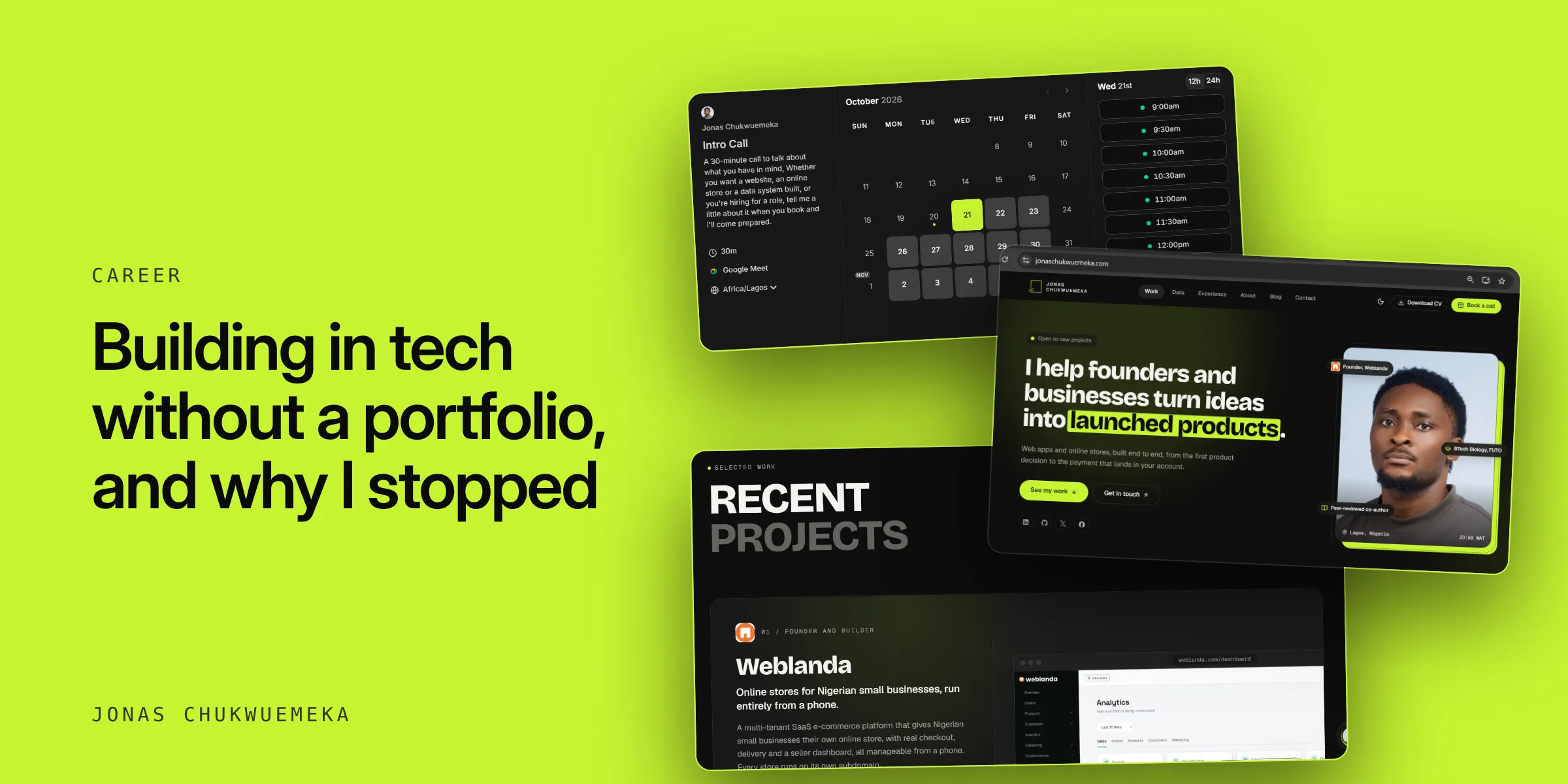
You’ll find my work, including Weblanda, an online store platform for Nigerian small businesses, and Formtified, a tool that turns a short brief into a client onboarding form. There’s also a data lab with my data engineering projects, my experience, my education and research, and a way to book a call or get in touch.
And there’s this blog. I’ll use it to write about what I’m building, how it works, and what I’m learning as I grow into data engineering. Blogging is part of how I want to build a real presence on the web, not just a page that sits there.
What I think about AI
I used AI while building this site, mainly Claude Code, an AI coding tool. It helped me move much faster than I would have alone.
But here’s how I see it: AI is an accelerator. It helps you ship faster. It doesn’t replace knowing what you’re doing.
If you don’t understand the fundamentals, you can’t tell when the AI is wrong. And it will be wrong sometimes, while sounding completely sure of itself. During this build, it once told me a figure on my site came from my CV. I checked, and it didn’t. If I hadn’t known my own work well enough to check, that mistake would have gone live.
Domain knowledge matters just as much. One of my projects turns my published research on biogas production into a data platform. AI can help write the pipeline code, but it can’t tell whether the biology makes sense. That part came from years of studying it.
That’s the difference I keep coming back to. Without fundamentals and domain knowledge, you’re just a user of AI. With them, you’re a developer who uses AI to build faster. I want to be the second one.
What’s next
I’ll be writing about my projects, the decisions behind them, and what I learn along the way. If any of it is useful to you, the newsletter below is the easiest way to get the next post.

Written by
Jonas Chukwuemeka
Full-stack developer and founder of Weblanda. I build web apps and online stores from Lagos, and I'm growing into data engineering.